Replace it if it has rewireable fuses, no RCD protection, a wooden backboard, scorch marks or a hot smell, or if an EICR has coded it C1 or C2. A plastic board with working RCDs that passes its tests can usually stay. Most Greater Manchester homes pay £449 to £750 for a replacement, fitted and certified in one day.
The nine signs
- Rewireable fuses. Ceramic or bakelite carriers with fuse wire inside. They work, but there is no RCD protection anywhere in the house, and the wire is easy to replace with the wrong rating.
- No test button. If nothing on the board says "Test" or "T", there is no RCD. That is the device that cuts the power in milliseconds when someone touches something live.
- A wooden backboard or a cast-iron switchfuse. Common in cellar heads across Salford, Oldham and Stockport. Usually fifty years old or more.
- Scorch marks, buzzing or a hot smell. This one is urgent. Switch off at the main switch if it is safe to do so and call an electrician today.
- Trips you cannot trace. One RCD switching off half the house is a design problem rather than bad luck. See why a fuse box keeps tripping.
- An EICR has coded the board C1 or C2. The report is unsatisfactory until it is put right. Landlords have 28 days.
- Gaps, missing blanks or broken covers. Any opening that lets a finger reach live parts is a danger, not a cosmetic issue.
- No spare ways. An EV charger, electric shower or extension needs a way of its own. A board with no room means a second board or a replacement.
- Red and black wiring at the board. Those colours stopped in 2004. On its own that is not a fault, but it dates the installation, and boards of that age usually have one RCD for half the house, or none at all.
What can safely wait
Not every old board needs to come out. If yours is a plastic consumer unit from the late 2000s or early 2010s, has RCD protection, shows no sign of heat and passes its tests, it is doing its job. Plastic is not illegal. The rule changed for new installations in 2016, and it is not retrospective. We explain it in is a plastic consumer unit illegal?
A dual-RCD board is the same story. It is safe, but one fault switches off a whole side of the house. Upgrading to RCBOs is an improvement, not an emergency. RCD or RCBO explains the difference.
We will tell you if your board is fine. If we think it can stay, we say so, and the photo assessment costs you nothing.
What a replacement costs in 2026
| Package | Typical home | Fixed price |
|---|---|---|
| Up to 6 circuits | Flats, two-up two-down terraces | £449 |
| Up to 10 circuits | Three-bed semis, bigger terraces | £549 |
| 11 or more circuits | Extended and detached houses | £695 |
Every package includes a metal 18th Edition consumer unit, an RCBO on every circuit, surge protection, dead and live testing of every circuit, the Electrical Installation Certificate and Part P notification. The only planned extras are an earthing upgrade (£80 to £160), new meter tails (£60 to £120) and main protective bonding (£80 to £150), and we price those from your photos before you book. See the full price breakdown.
Check yours in two minutes
Take three photos on your phone. They are the same three we use to send a fixed price:
- The board itself, cover open if it has one, from about an arm's length away.
- The meter tails, the two thick cables between the meter and the board.
- The earthing, usually a green and yellow cable clamped near the meter or the incoming supply.
Send them by the form or WhatsApp and a qualified electrician will reply within two working hours, 8am to 8pm, seven days, with a written price fixed for 30 days.
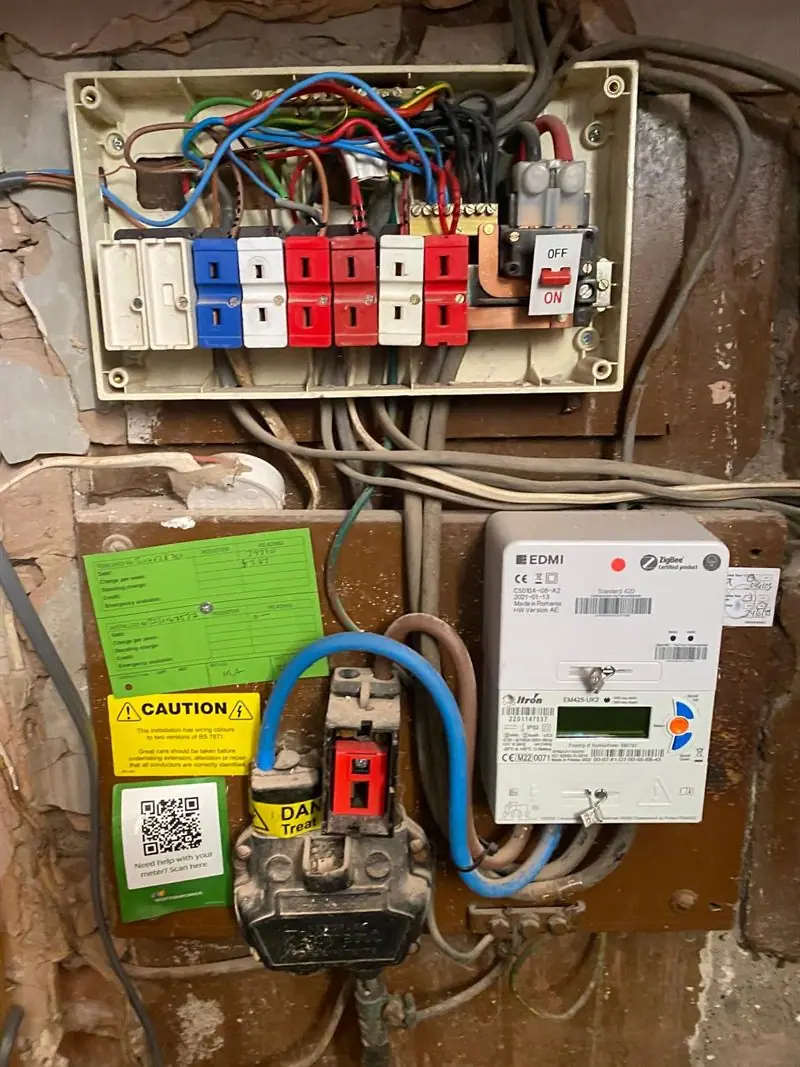 Before
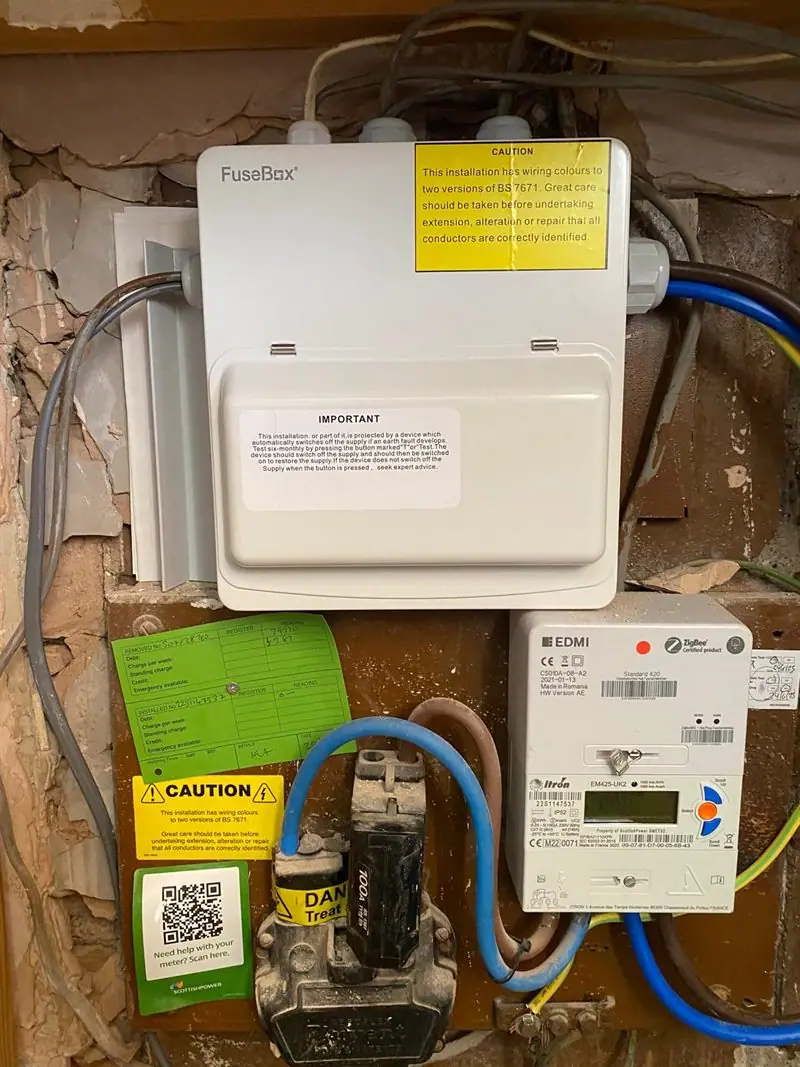 After
After